
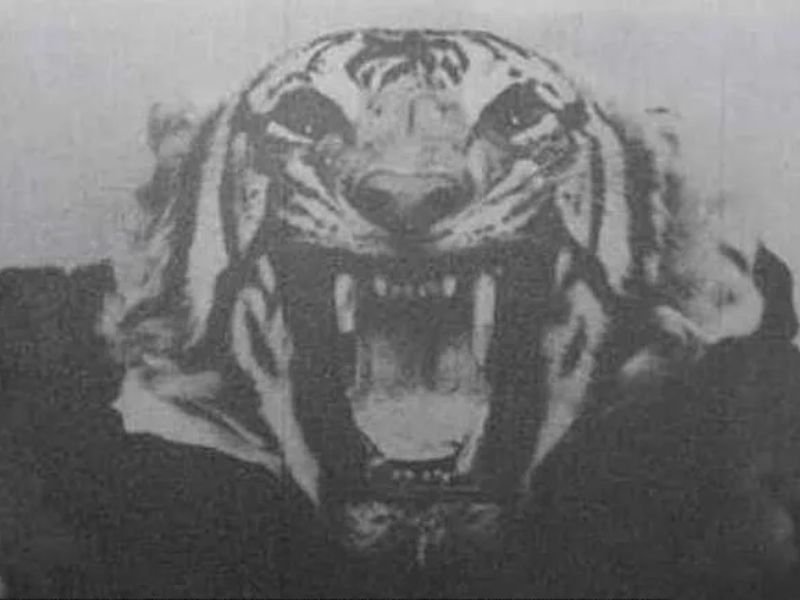
NEPAL AND INDIA – In the early 1900s, a tigress emerged from the jungles of Nepal carrying a grudge no one could have predicted. Years earlier, a young hunter seeking to prove himself had fired a shot meant to kill her, instead shattering her upper and lower canines and leaving her unable to hunt the prey she’d relied on her whole life. What followed became the deadliest known man-eating rampage in recorded history.
A Wound That Created a Killer
Unable to chase down her natural prey with broken teeth, the tigress turned toward something far easier to catch. Her first documented kills came in the village of Rupal at the edge of the Himalayas, where between 1899 and the early 1900s she is believed to have killed and consumed roughly 200 people, mostly women and children gathering supplies near the jungle’s edge.
The Nepalese army eventually organized an elaborate hunt, funneling villagers, elephant-mounted hunters, and armed soldiers into a “U” formation meant to corner her along the Sharda River. Cornered on the riverbank, the tigress leapt into the rushing water and emerged on the opposite bank, crossing into India and entering the Champawat district, a region that would soon carry her name and her legend.
A Reign That Paralyzed an Entire Region
From 1900 to 1907, the tigress terrorized the Kumaon region, her kill count climbing past 400. She struck in broad daylight, dragging victims for miles to avoid trackers, evading bounty hunters and traps with unnerving precision. Villages emptied. Funerals went unheld. Entire communities grew so paralyzed with fear that people refused to step beyond their own doorways for days at a time.
Enter Jim Corbett, a hunter and naturalist born in India in 1875 who held a rare respect for both wildlife and the rural communities living alongside it. When the Champawat tigress’s killings brought entire regions to a standstill, Corbett was called upon, not for glory, but out of grim necessity.
Corbett’s Hunt Through Blood and Fear
Arriving in the village of Pali in May 1907, Corbett found a place gripped by terror, residents too afraid to leave their homes for five straight days. He tracked the tigress through scenes of horrific violence, including the aftermath of a 16-year-old girl’s killing, describing finding a severed leg at the edge of a blood-tinged pool, a memory he later called the most pitiful sight of his man-eater hunting career.
After a near-fatal encounter where the tigress nearly ambushed him from above, Corbett organized nearly 300 armed villagers, many seeking vengeance of their own, into a coordinated drive meant to push the tigress toward where he lay waiting.
The Final Stand
When the beaters’ signal came early, chaos erupted across the gorge, and the tigress burst forward at full speed. Corbett’s first shots missed. Hers and the Tahsildar’s shotgun blast went wide too. As the tigress turned back toward him for a final charge, Corbett fired three rounds, wounding her, before realizing his rifle was empty. Sprinting to a nearby tree, he grabbed the Tahsildar’s spare shotgun and turned to face her mid-charge, firing the shot that finally ended her seven-year reign.
Examining her body afterward, Corbett confirmed what he’d suspected all along, her shattered canines, the lingering wound from that long-ago bullet that had set her entire rampage in motion.
A Legacy Beyond the Kill
The hunt reshaped Corbett’s life. He came to see the tigress not as a monster, but as an animal driven to desperation by human harm. That conviction turned him into one of tiger conservation’s earliest and most influential advocates, work that eventually led to the creation of Jim Corbett National Park, India’s first national park and a lasting sanctuary for the species he once hunted.
Stay updated for more wildlife history stories as this story develops.
Leave a Reply