
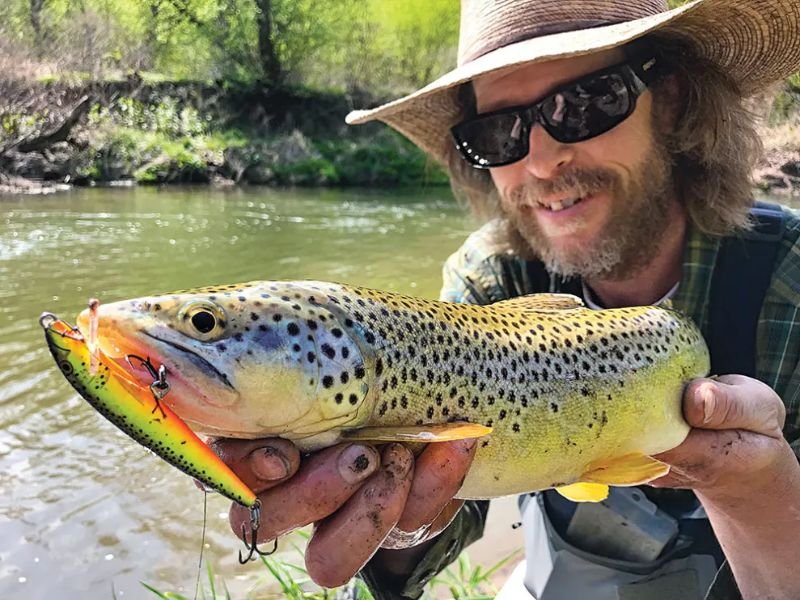
IOWA – Dave Strom has spent his whole life fishing the small streams of Iowa’s Driftless Region, and by his own standards, a trout outing only counts as a success if he lands a brown measuring 24 inches or better. Strom, 44, has done it many times over, with a personal best reaching 30 inches and 14 pounds. His aggressive, run-and-gun approach to small-water trout fishing offers anglers everywhere a different way to find trophy fish, even on streams they thought they already knew well.
Focus on the Lower Stretches of the Stream
Strom said trophy trout success starts with fishing where big fish actually live, which is often the lower third of a stream rather than the picturesque upper sections most anglers gravitate toward. These lower stretches tend to be silted in, with muddy bottoms, slow current, and plenty of fallen trees in the water.
Most anglers skip these areas, assuming fewer trout live there. Strom said that’s true, but he isn’t chasing numbers. A hole tucked into weakened, stained flow with heavy cover is far more likely to hold one or two true giants than a clear, pristine pool farther upstream, and fishing these overlooked stretches often means having miles of water entirely to himself.
Move Fast and Don’t Linger on a Spot
Strom describes himself as a run-and-gun trout fisherman, covering as many likely trophy spots as possible in a single short outing, sometimes just a few hours after work. He keeps his distance whenever he can, casting long to reach the sweet spot of a hole rather than wading in close.
In a deep hole with strong cover, he might cast four times; in a shallow pocket with little cover, just once or twice is enough. If a big trout is present and willing to bite, Strom said it reacts quickly, so there’s no reason to work a spot for long. If he misses or turns a fish, he moves on immediately and gives that hole at least 20 minutes to rest before trying it again.
Go Big and Flashy Instead of Small and Subtle
Strom experiments constantly with bait, from 6-inch soft-plastic swimbaits to paddle-tail shads rigged with a large Colorado blade, but his most consistent producer remains a 5½-inch No. 14 Rapala Husky Jerk. Working it down-current, he retrieves at high speed with hard, violent rod snaps.
In his experience, that aggressive flash is what triggers the biggest fish, even ones that have already eaten, by playing directly to their predatory instincts rather than trying to make them hungry. Strom said other anglers sometimes laugh when they see him tie on a big Husky Jerk on small water, but he’s content letting them stick to catching smaller fish while he targets something bigger.
Stay updated for the latest outdoor and fishing news as this story develops.
Leave a Reply