
Over the past two centuries, dozens of species across the globe have vanished entirely, most of them pushed out of existence by human activity rather than natural decline. These two extinctions tell very different stories, but share the same underlying cause.
A Bird That Once Numbered in the Billions
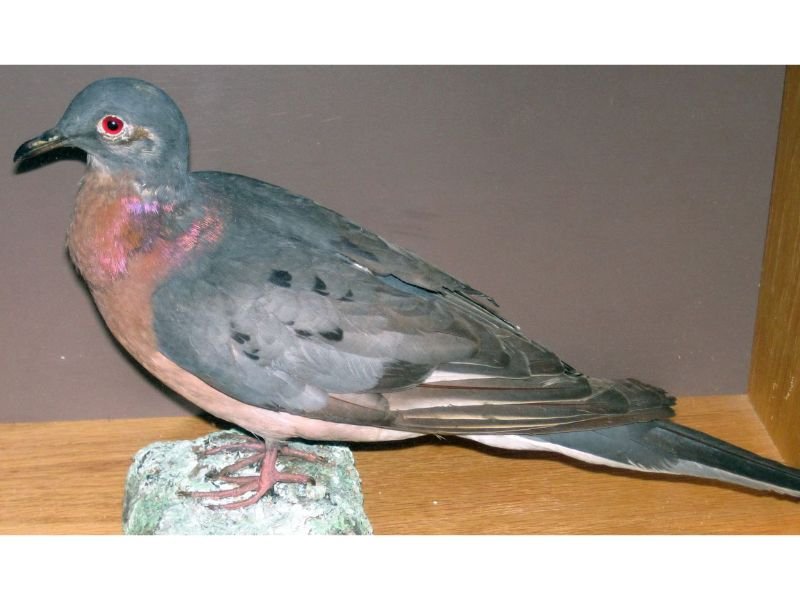
The passenger pigeon was once the most numerous bird in North America, and possibly on Earth. Estimates put its pre-colonization population between three and five billion individuals.
Flocks were so massive they reportedly darkened the sky for hours. Early accounts describe their wings sounding like rolling thunder, with droppings falling like snow beneath the passing birds.
The species was a medium-sized pigeon with a slate-blue head and rust-red breast. It was nomadic, following the oak, beech, and chestnut forests that supplied its food, with nesting colonies sometimes stretching across hundreds of square miles.
Hunted to Extinction in Under a Century
That scale collapsed once commercial hunting reached an industrial level. Birds roosted in trees where they could be knocked down with poles, and a single hunter could kill hundreds in a day. Millions were shipped to cities like New York and Chicago every year by the mid-1800s.
At the same time, the mast forests the species relied on were being cleared rapidly. Passenger pigeons appear to have needed enormous colony sizes just to trigger breeding, so as numbers fell, reproduction slowed even before the last birds vanished.
A species numbering in the billions in 1800 was functionally extinct in the wild by the 1890s. Martha, the last known individual, died at the Cincinnati Zoo on September 1, 1914. Her death helped drive passage of the Lacey Act of 1900, among the first federal wildlife protection laws in U.S. history.
A Leopard That Vanished Without a Trace
The Formosan clouded leopard was a subspecies found only on Taiwan. It was declared extinct in 2013, following a 13-year camera trap survey that never produced a single confirmed image of a living animal.
The clouded leopard is known for its long body, short legs, and the largest canine teeth relative to skull size of any living wild cat. Its coat features large, cloud-shaped patches that give the species its name.
Taiwan’s Rukai people held deep cultural reverence for the animal, considering it sacred and never hunting it themselves. That cultural protection likely helped the population survive longer in southern Taiwan than it otherwise would have.
Habitat Loss Proved Unstoppable
Despite that reverence, habitat destruction sealed the subspecies’ fate. Taiwan’s lowland forests were extensively logged during the Japanese colonial period from 1895 to 1945, and logging continued for decades afterward, fragmenting what remained.
Hunting for pelts and incidental trapping added further pressure. The last physical evidence of the animal, a skin and bones, was recorded in 1983, and the 13-year survey that began in 2000 confirmed what years of absent sightings had already suggested.
In 2019, members of the Rukai community reported possible sightings in southern Taiwan, though no photographic evidence has surfaced. Conservationists have since proposed reintroducing clouded leopards from mainland populations into Taiwan’s recovering forests.
Stay updated for more wildlife and conservation stories as this story develops.
Leave a Reply